Meta + T-Mobile eSIM UX Writing
Role
Content Designer
Team
1 content designer (me), 1 product designer, 1 UX researcher, 2 engineers, 1 product manager
Timeframe
6 months
Company
Meta & T-Mobile

Overview
Trying a new mobile network from a Facebook ad asks people to trust an unfamiliar process. I wrote all content on every screen of Meta and T-Mobile’s eSIM experience and contributed to the design and layout. My work covered the offer, setup instructions, tutorial script, and research-informed revisions that helped people understand what would happen to their existing service.
Explain the unfamiliar
An eSIM is a digital SIM built into a compatible phone. The content challenge was translating that technology into a practical benefit: try another network without visiting a store or waiting for a physical SIM. People needed enough explanation to act without first becoming experts in mobile connectivity.
Separate a trial from a switch
The trial let people experience T-Mobile’s network before committing to a carrier switch. That distinction needed to carry from the ad into the welcome screen and setup instructions: what people could try, for how long, and whether they needed to leave their current carrier.
Turn technology into a clear next step
A digital activation removes the physical SIM, but people still need to understand compatibility checks and phone settings. I treated those moments as content problems: explain unfamiliar terms where they appear and make the next action concrete.
Keep the promise from ad to activation
The team’s hypothesis was that a native Facebook flow could reduce the friction of downloading another app. The content needed to preserve the offer’s meaning through every handoff, including the move from Facebook into iOS settings.
Content strategy
Aligning goals and information needs
Meta
Support a new acquisition channel with an offer people can understand and an activation journey they can complete.
Telcos
Explain the network trial and plan options clearly enough to help prospective customers evaluate them.
Users
Know what the trial includes, how setup works, and what happens to existing service before making a commitment.
Write, research, and refine
I partnered with T-Mobile and the product team on a phased trial experience. We used research to identify missing information and refine the flow, while the program tracked acquisition cost from ad to carrier switch.

The existing T-Mobile app is already getting good results, so improving upon the current conversion will be a challenge.
#1
largest eSIM campaign
4K
New users a day
17%
switch to T-Mobile
$1.25M
Additional partner ad spend
Customer Journey
I organized the journey around four information needs: understand the offer, evaluate it, provide details, and complete setup.
Attract
Introduce the trial with a clear offer that is relevant to the person seeing the ad.
Education
Explain the benefits and conditions before asking people to continue.
Collect
Make it clear what information is needed and reduce effort with prefilled details.
Activate
Guide setup and confirm completion so people know where they stand.
10 Minutes from Ad to Activation
UX Writing
The eSIM trial
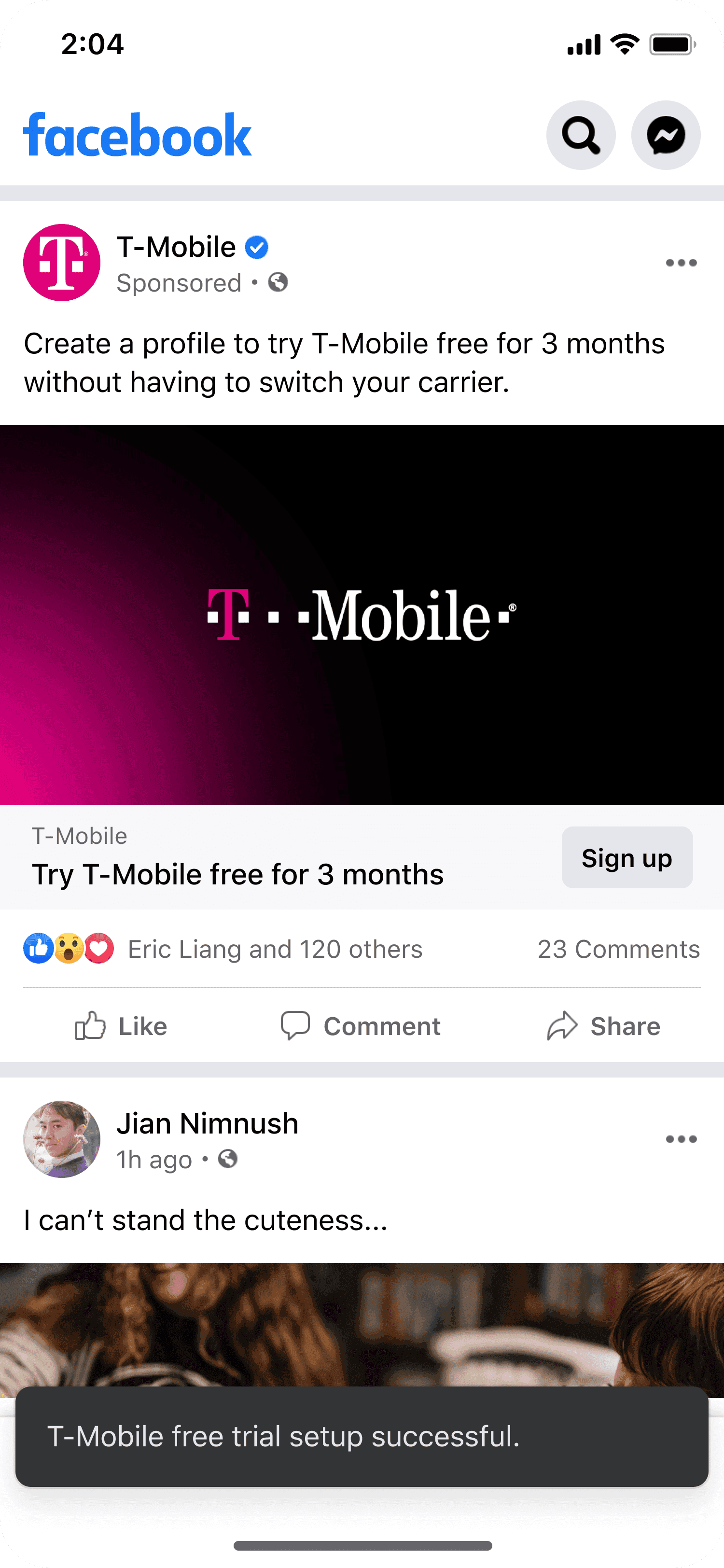
The opening copy introduced a free three-month trial without requiring an immediate carrier switch. I carried that promise into the welcome screen, then sequenced the account and contact details needed to proceed. The writing needed to build confidence before the flow asked for effort.


The compatibility step introduced an unfamiliar identifier: the IMEI associated with an available SIM. This was a point where instructional content had to connect a technical requirement to a task people could complete on their phone.


Setup crossed two environments: Facebook and iOS settings. The tutorial explained installation before a notification took people into settings. A completion message then confirmed success back in Facebook. Each piece of content had a different job: prepare, direct, or reassure.


I wrote the tutorial script and led production of English and Spanish versions. The script was a core content deliverable: a step-by-step explanation of eSIM installation that people could follow as they moved into their phone’s settings.
Prototype
Try out the eSIM Trial
If you would like to try out the Meta and T-Mobile eSIM trial tap the link below.
eSIM Trial Prototype ↗
Content Research
The next use case, direct switch, asked for a bigger commitment than a trial: move to a new carrier from a Facebook ad. We needed to understand what information would help people evaluate that decision.
I worked with UX researchers to shape the research plan and interview questions, and participated in the research process. We explored cost, commitment, setup, and the effect on existing service to inform the T-Mobile direct-switch flow.
The team needed to learn which unanswered questions prevented people from starting or completing the flow.
We explored those questions through qualitative research and iterative flow revisions. I used the findings to make the content more explicit at decision points.
Interviews
11 in-depth interviews and iterative design explorations with FB users in New York, in-person in the Meta labs.
Research Qualifications
• Participants previously used a variety of carriers
• All used FB in the month prior to the UXR
• All have a credit card
• All use an iPhone
• Age breakdown:
• 5 young adults (18-29 years old)
• 6 older adults (30 years old and above)
Experience Switching Carriers
• 7 have switched carriers in the past
• 4 who haven’t switched carriers in the past
Type of Carrier Account
• 3 with independent accounts
• 8 with family plans
• 6 are the account owners
• 2 are not account owners, but are involved in plan decision-making
Example Research Questions
• What are contributing factors involved in decision-making when it comes to carrier switching?
• How do users feel about switching carriers online and using eSIM?
• What is your reaction to the direct switch product on FB?
• What are the main barriers to completing the flow?
• How do you feel about setting up eSIM on your own?
Quote 1
“Switching took me about a month. I worried about the hassle of it all. I remember you had to change phone numbers. The fear of switching was worse than what it actually was.”
Female, 30-34
Quote 2
“Online, I would struggle with it. I need confirmation, to understand it is all set up, [that] no one charges me on the other side, what fees I should pay for changing, the [length of the] contracts that you have.”
Female, 55-64
Quote 3
“I would like to see very clear stuff, like costs, limits, what I am getting - all the details. I would feel more comfortable if everything was more clear. If not then I’d prefer to interact with someone.”
Female, 35-44
Quote 4
“I would like to learn how to switch by myself. I know [the eSIM has] a sequence that exists in my settings and it’s a secure way to switch… But since I don’t know how this works I would prefer a phone rep to go through this with me.”
Female, 30-34
Quote 5
“It does not tell me what is happening with my current provider. Are you handling that in the background? Is there something I should do on my side?”
Female, 35-44
Quote 6
“I would want to check if this is a specific FB offer, or am I missing on better offers on T Mobile’s website. I’m looking for the fine print, the final costs, really clearing out the features. I’d be curious to see what adding a line would take and cost, if I would want to bring my partner.”
Male, 18-29
Finding 1
While participants are open to switching carriers or trying eSIMs online for the right deal or network upgrade, the high perceived complexity and weight of these decisions mean they require strong digital assurances, thorough information, and access to human support to overcome anxieties and complete the process.
Finding 2
The experience needs to minimize early barriers by immediately highlighting enticing offers, clarifying high-commitment calls-to-action, and proactively addressing key information to keep users confidently within the funnel.
Finding 3
Participants wanted to understand the offer and switching process before committing. Proposed refinement: use “Learn to Switch” on the combined trial-and-plan page. My hypothesis is that this CTA would set the expectation of guidance on the next screen, reducing uncertainty about whether tapping it immediately starts a carrier switch.
Customer Journey
We built this user journey map to translate our raw research data into a chronological, empathetic narrative that highlights exactly where our product can relieve friction.

Personas
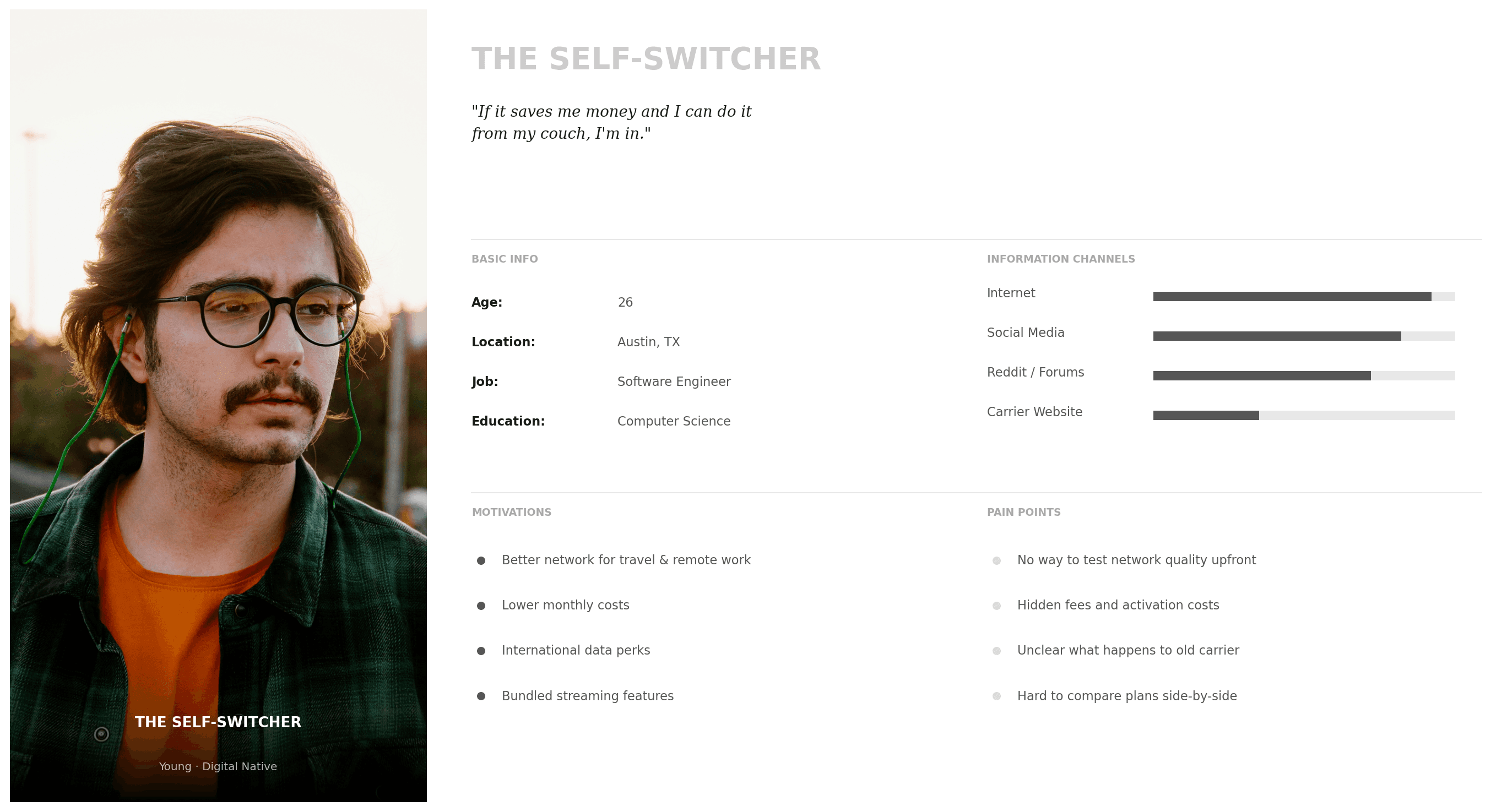
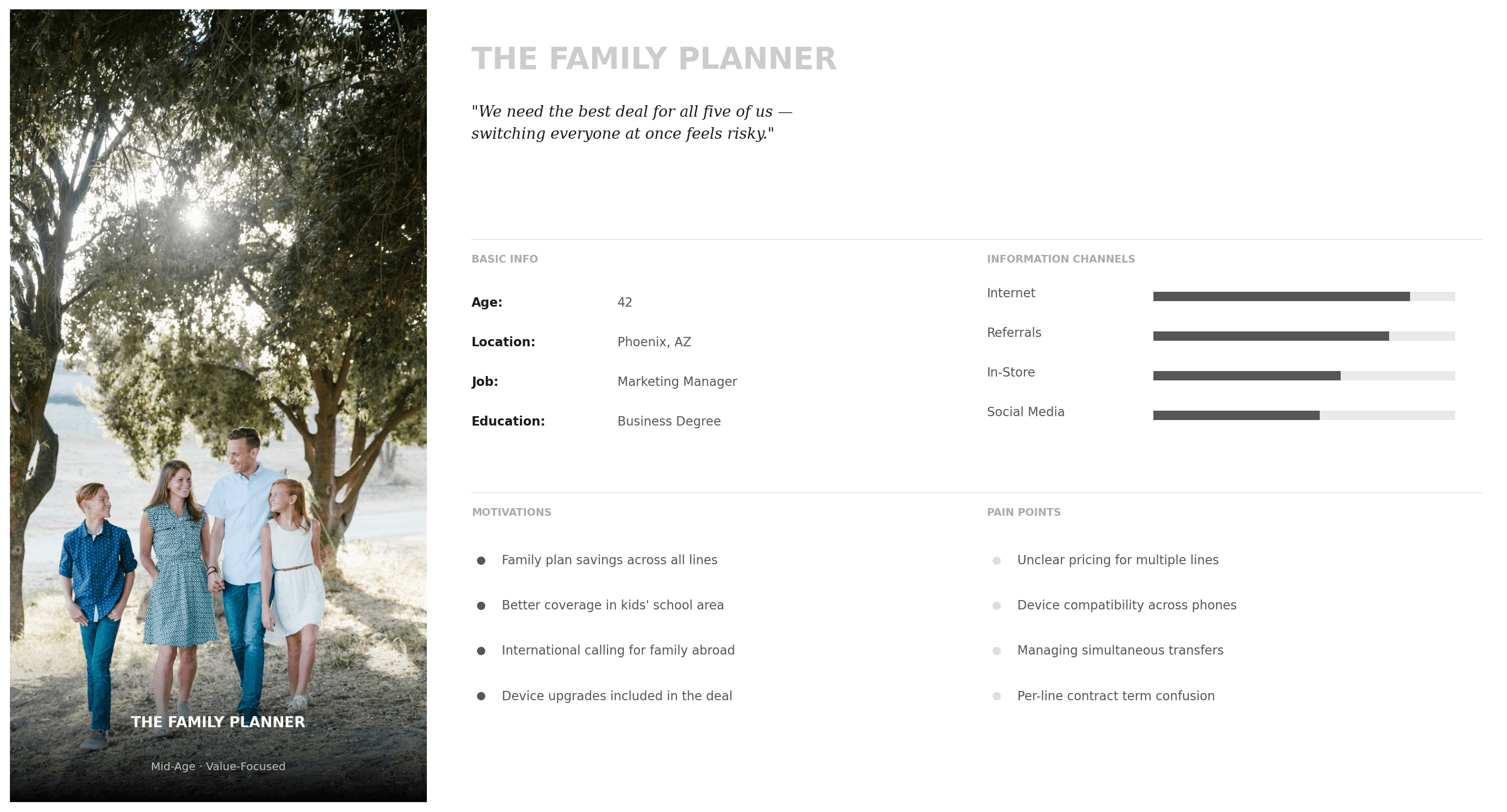
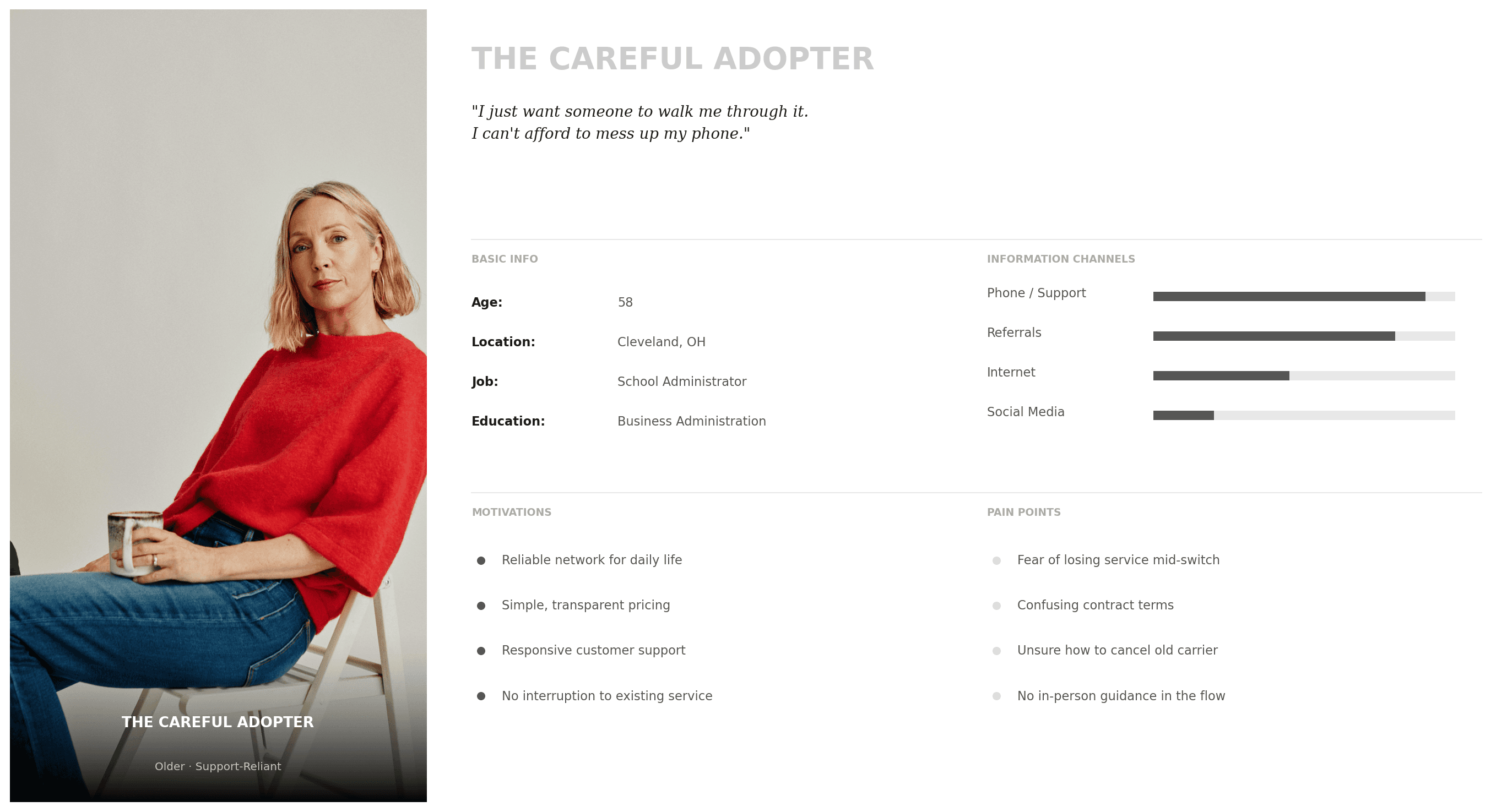
To build inclusive designs that cater to distinct user needs, we synthesized qualitative user interviews and quantitative survey data from our initial UX research into three dynamic behavioral personas. Rather than relying on superficial demographics, these personas served as realistic composites of the real users we interviewed, capturing their technical aptitude, setup anxieties, and specific motivations around the eSIM onboarding lifecycle.
Main takeaways
Here are the key insights and concerns raised by participants during our user research sessions.
The Power of Family Consultation & Offers
Switching carriers is a major commitment. Most participants need to consult with a partner, family members, or friends first. For this reason, they want a way to easily save or return to the ad later. Participants are actively questioning the nature of the partnership between T-Mobile and Meta that enabled this promotion, specifically wondering if this deal is a Facebook exclusive or if the same exact offer is available through T-Mobile’s standard retail and digital channels.
Perceived Value of Family Plans
Every participant operated under the assumption that family plans are inherently more cost-effective per person than individual plans. Users are actively looking for a complete, centralized breakdown of all ongoing costs and specific contract details, while wanting clear direction on exactly where and how to contact customer support if they have questions.
Phone Upgrade and Financing Habits
Many users prefer financing their phones by rolling the cost directly into their monthly bill, typically repeating this cycle to upgrade their device every 2 to 3 years.
Anxiety Over Carrier Off-boarding
A primary concern for users is the mechanics of leaving their old provider. They are unclear on whether they must manually cancel their existing service or if T-Mobile will handle the transition for them.
Revising the information hierarchy
The research changed what we explained, when we explained it, and how people could return when they were ready.
Problem
People wanted pricing and plan details before committing to a trial. They also had unanswered questions about compatibility, existing contracts, and family plans. Because the entry point was a feed ad, people who left to research the offer worried they would lose their place.
Solution
We added plan comparison, plan details, and a combined trial-and-plan view so people could evaluate the offer before proceeding. A reminder offered a way back after consulting family or comparing options. My hypothesis is that making the decision easier to revisit would support people who needed more time, without adding pressure to commit.


Compare plans
Plan details
Combined trial + plan
Set a reminder
Instruction format 1: carousel


Instruction format 2: one page

Six participants performed better with the plain one-page instructions than with the carousel or video, finding the text easier to understand and reference during setup. They could save a screenshot and return to the steps. My interpretation is that self-paced, persistent instructions reduced the need to remember a video while moving between Facebook and phone settings.
Results
Program outcomes
The figures below combine the T-Mobile trial and direct-switch campaigns after improvements to the flow. They reflect the overall program. The study did not isolate the effect of copy changes.
51%
Reduced customer acquisition cost
$1.25M
In additional partner ad spend
70%
Revenue Growth
Next Steps
• We aim to develop a ‘travel’ eSIM campaign targeting frequent flyers between the US and Europe. Mirroring the framework of our ‘direct switch’ campaign, this initiative promotes tailored eSIM data packages to capture consistent international roaming traffic and unlock additional revenue streams.
• We also set out to integrate our ‘direct switch’ framework with multi-line family plans. By streamlining the simultaneous activation of multiple eSIMs, our goal is to seamlessly transition entire households at once, capturing a massive and highly lucrative segment of the market.